IPO Day One: The Numbers
- Offering Price: $135/share
- Opening Price (June 12): $150
- Closing Price: $160.95 (+19%)
- Midday Peak: $186.15 (+30%)
- Total Raised: $75 billion
- Musk's Voting Power: 85.1%
- Underwriter Fees: ~$500 million
The Biggest IPO Ever—And It's Not Close
SpaceX's $75 billion raise dwarfs every IPO before it. For context, Alibaba's 2014 debut—previously the record holder—raised $25 billion. This is three times that.
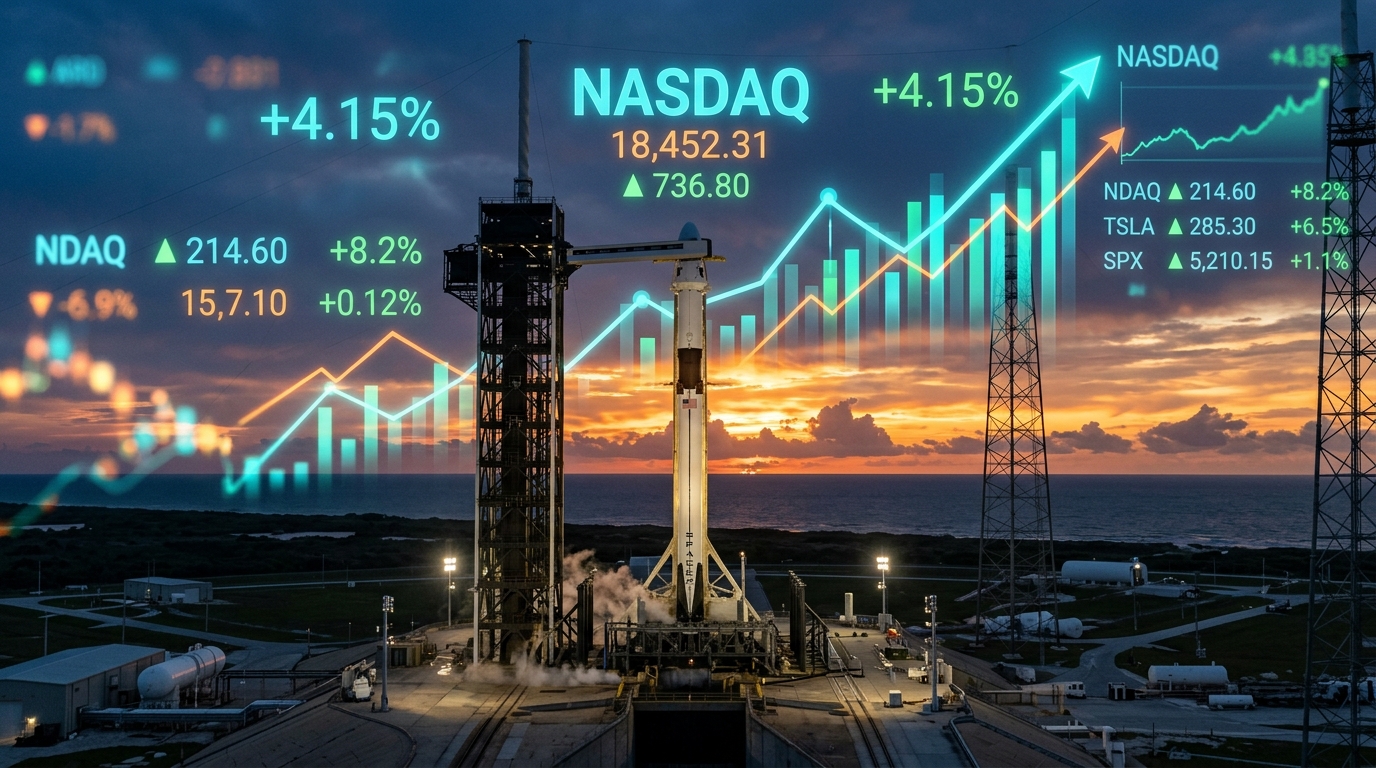
Shares opened June 12 at $150 on Nasdaq, an 11% pop. By midday, they'd soared 30%. The stock closed at $160.95, and the next day pushed past $186. Robinhood reported record-breaking platform traffic within hours of the debut.
Goldman Sachs and Morgan Stanley led the underwriting syndicate and split roughly $500 million in fees, per the Wall Street Journal. The so-called 'green shoe option'—a provision letting underwriters sell up to 15% more shares if demand is strong—was reportedly exercised. Insiders celebrated by wearing green shoes in a group photo posted to X.
Elon Musk: The World's First Trillionaire
The IPO boosted Musk's paper wealth past $1 trillion, making him the first person to cross that threshold. He holds 85.1% of SpaceX's voting power—a level of control that goes far beyond what founders at Meta, Google, or Snap enjoy.
On X, the social media platform he owns, Musk posted Friday afternoon: 'I love the incredible people of SpaceX beyond words.' He also reposted IPO coverage and the green-shoe photo.
But Musk's dominance comes with tensions. The New York Times estimates that 4,400 SpaceX employees could become millionaires from the IPO—yet lower-tier SPV investors face hidden fees, lengthy payout delays, and in some cases, the risk of outright fraud, according to TechCrunch reporting.
Shotwell Floats a Tesla Merger on CNBC
In a June 12 interview with CNBC, SpaceX COO Gwynne Shotwell made a comment that sent Tesla shareholders into a frenzy. When asked about the company's future, she said: 'A merger between SpaceX and Tesla might make Elon's life a little easier.'
The remark was offhand, but given the context—SpaceX's new S-1 includes language warning investors of 'future dilution'—it added fuel to speculation that Musk is eyeing some kind of corporate consolidation. Tesla's stock ticked up in after-hours trading.
What the S-1 Actually Says
SpaceX's S-1 registration document gave the public its first real look inside the company's financials. The picture is messy: SpaceX lost $4.9 billion in 2025 on revenues of over $18 billion. Since inception, cumulative losses exceed $37 billion.
Starlink, the satellite internet service, dominates the business. The S-1 details heavy investment in AI through xAI, Musk's other venture, and outlines SpaceX's compute deals with Anthropic ($1.25 billion per month) and Google ($920 million per month). Both contracts were signed in the run-up to the IPO to improve the balance sheet.
Starship, SpaceX's next-generation rocket, is central to the company's long-term vision—but the path to full reusability remains unclear. TechCrunch's analysis of the S-1 and recent test flights suggests the timeline may disappoint both boosters and critics.
Who Wins (and Who Doesn't)
Elon Musk (85.1% voting control)
Musk's stake is worth over $1 trillion on paper. He holds monarchical control over the publicly traded company—far beyond what Zuckerberg, Page, or Spiegel have at their firms. His wealth and political power have never been higher, even as public opinion polarizes.
Early Employees & Inner Circle (~4,400 new millionaires)
The New York Times estimates 4,400 SpaceX employees will become millionaires. Most of the wealth, however, concentrates in Musk's inner circle. Gwynne Shotwell and a handful of early backers stand to gain billions.
Goldman Sachs & Morgan Stanley ($500M in fees)
The two lead underwriters split roughly half a billion dollars in fees. Goldman and Morgan Stanley were the clear winners among the banks.
SPV Investors (Locked up, unclear payout)
Lower-tier special purpose vehicle investors face post-IPO lock-ups, hidden fees, and delayed payouts. Some may not know their true holdings until restrictions lift—and in the worst cases, they risk fraud.
What Happens Next
SpaceX is now subject to quarterly earnings reports, SEC scrutiny, and the demands of public shareholders. The company's S-1 warns of potential future dilution, which could mean more share issuance or even a major corporate transaction.
The merger speculation won't go away. Shotwell's comment, combined with language in the S-1, suggests Musk may be considering ways to simplify his sprawling empire—SpaceX, Tesla, xAI, X, Neuralink, and The Boring Company.
For now, the stock is surging. Whether that momentum holds depends on whether SpaceX can turn its $37 billion in cumulative losses into sustainable profit—and whether Starship can deliver on its reusability promise.
FAQ
Why did SpaceX go public now after 24 years private?
SpaceX hasn't publicly stated a single reason, but the timing follows years of high cash burn and cumulative losses exceeding $37 billion. The IPO raised $75 billion, giving the company a massive capital cushion. Pre-IPO, SpaceX also locked in major compute deals with Anthropic and Google to strengthen its balance sheet.
What does Elon Musk's 85% voting control actually mean?
Musk holds 85.1% of voting power, meaning he can unilaterally decide corporate strategy, M&A, and board composition—even if other shareholders object. It's a level of control that exceeds what founders at Meta, Google, or Snap have. Public investors are effectively along for the ride.
Is a SpaceX-Tesla merger really on the table?
SpaceX COO Gwynne Shotwell said on CNBC that a merger 'might make Elon's life a little easier.' It was an offhand remark, not an official plan. But combined with dilution warnings in the S-1, it's fueling speculation that Musk is exploring ways to consolidate his companies.
How can I track the SpaceX stock price?
SpaceX is listed on Nasdaq. You can find the live price on Nasdaq's official listing page, Bloomberg, CNBC, or any major financial terminal. The ticker wasn't specified in the S-1 at the time of the IPO.
This content is for informational purposes only and does not constitute investment advice. SpaceX stock involves significant risk, including potential dilution and volatility. Past performance does not guarantee future results. Consult a licensed financial advisor before making any investment decisions.